
Note: PRECEDE is only compatible on desktop. Have feedback? Interested in collaborating?

Public Repository to Engage Community and Enhance Design Equity

Neuroinclusion

Learn about the people most impacted:

 “Neurodiversity isn’t a label or a diagnosis or a feel good term. It’s the idea that neurological differences like dyslexia, like dyspraxia, like autism, are natural and important in how humans think.”

Nathaniel Hawley

Sensory Processing Disorder (SPD) although not a medical diagnosis, may be used to describe variations in our sensory experiences. Those experience can lead to over or under responsiveness.

Hyper-sensitive: Describes over responsive sensory processing. For example, some people might be hyper-sensitive to sound; they might experience certain noises as overwhelming or even painful

Hypo-sensitive: Describes under responsive sensory processing. For example, some people may be hypo-sensitive to sound; which may lead them to seek out auditory stimulation

*This is not a linear experience, rather it is a spectrum. Individuals can be hyper-sensitive in some areas and hypo-sensitive in others.

Source:

Abbott, 2024

Oxford Health

Describes individuals whose brains function differently from societal norms. This encompasses various neurological conditions, including those present from birth (congenital) and those acquired later in life (neurodegenerative)
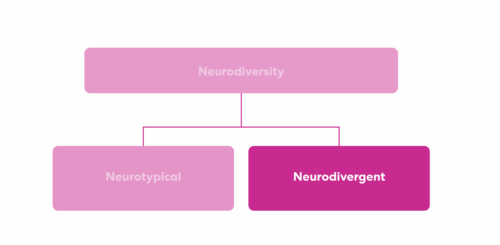
neurodivergent highlighted, a subsection of neurodiversity

Source:

Ramirez, 2023

Cleveland Clinic

group of people is neurodiverse. This describes the infinite variation in neurocognitive styles within our population.
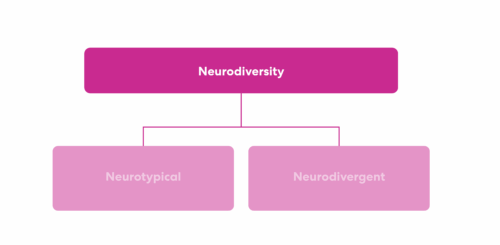
neurodiversity is an umbrella term for both neurotypical and neurodivergent

Source:

Northwestern Medicine

Walker, 2021

A plan, framework, and/or process for welcoming and promoting neurodiversity

Explore the following sources to learn more about what neuroinclusion could look like in:

Refers to an individual’s unique cognitive profile (personal identity). It should not be assumed that each identity (ADHD, Autism, Dyspraxia, OCD, etc.) looks the same for everyone. Rather if you have met one person with autism, you have met ONE person with autism.

It is important to remember that individuals may also have co-occurrence where they experience more than one neurotype.

Refers to individuals whose cognitive functioning, thinking, perceptions, and behaviors align with mythical societal standards. It is often seen as the opposite of neurodivergent.
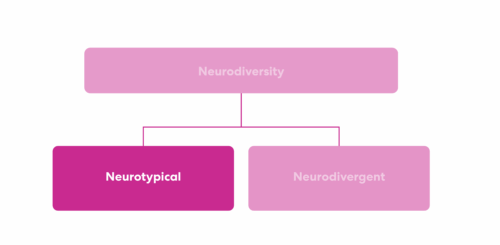
neurotypical is a subsection of neurodiversity

Source:

Cleveland Clinic

Walker, 2021

The 8 Senses

Our experience of the built environment is shaped by our sensory systems, how our bodies and minds take in and respond to space. Some individuals experience sensory input differently, which affects how they perceive and navigate their surroundings. By understanding the full spectrum of sensory experiences, designers can create environments that better support all users.

Other commonly used terms for each of the senses:
Auditory = Hearing
Gustatory = Taste
Interoceptive = Internal body awareness
Olfactory = Smell
Proprioceptive = External body awareness
Tactile = Touch
Vestibular = Balance
Visual = Sight
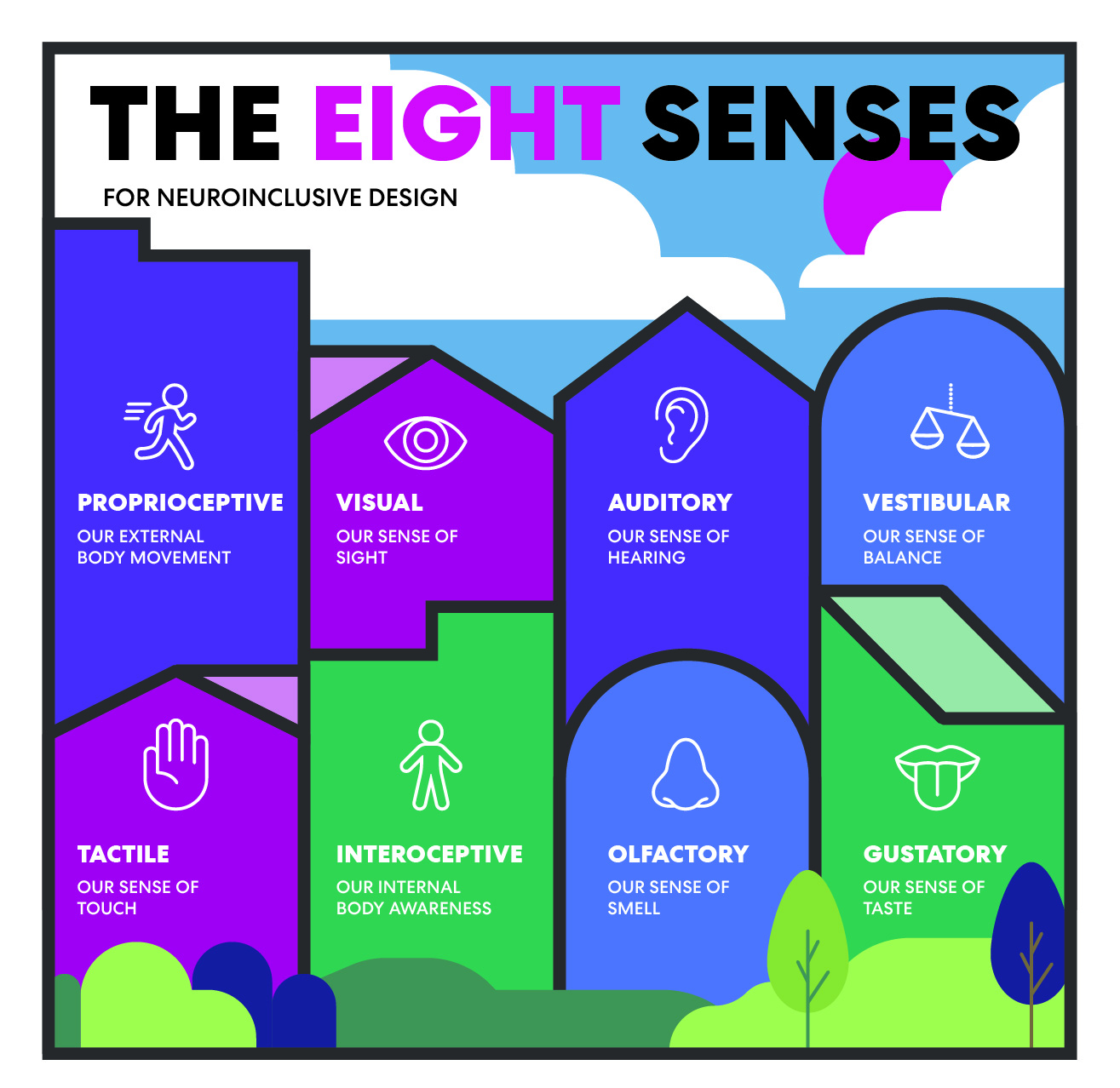
Visual Illustration of the eight different senses as different buildings in a cityscape.

Sources:
The Eight Sensory Systems Explained
8 Senses of the Body | Exploring the Hidden Sensory Systems

How Do People Vary In Sensory Experience?

Each individual experiences sensory input differently, which affects how they perceive and navigate their surroundings. These experiences are not black and white, rather they exist on a spectrum. Sensory experience is not static, rather it changes due to temporal and spatial contexts. We can use the terms “hypo-sensitive” (under responsive to sensory input) and hyper-sensitive” (over responsive to sensory input) to speak about the variability in sensory input. 
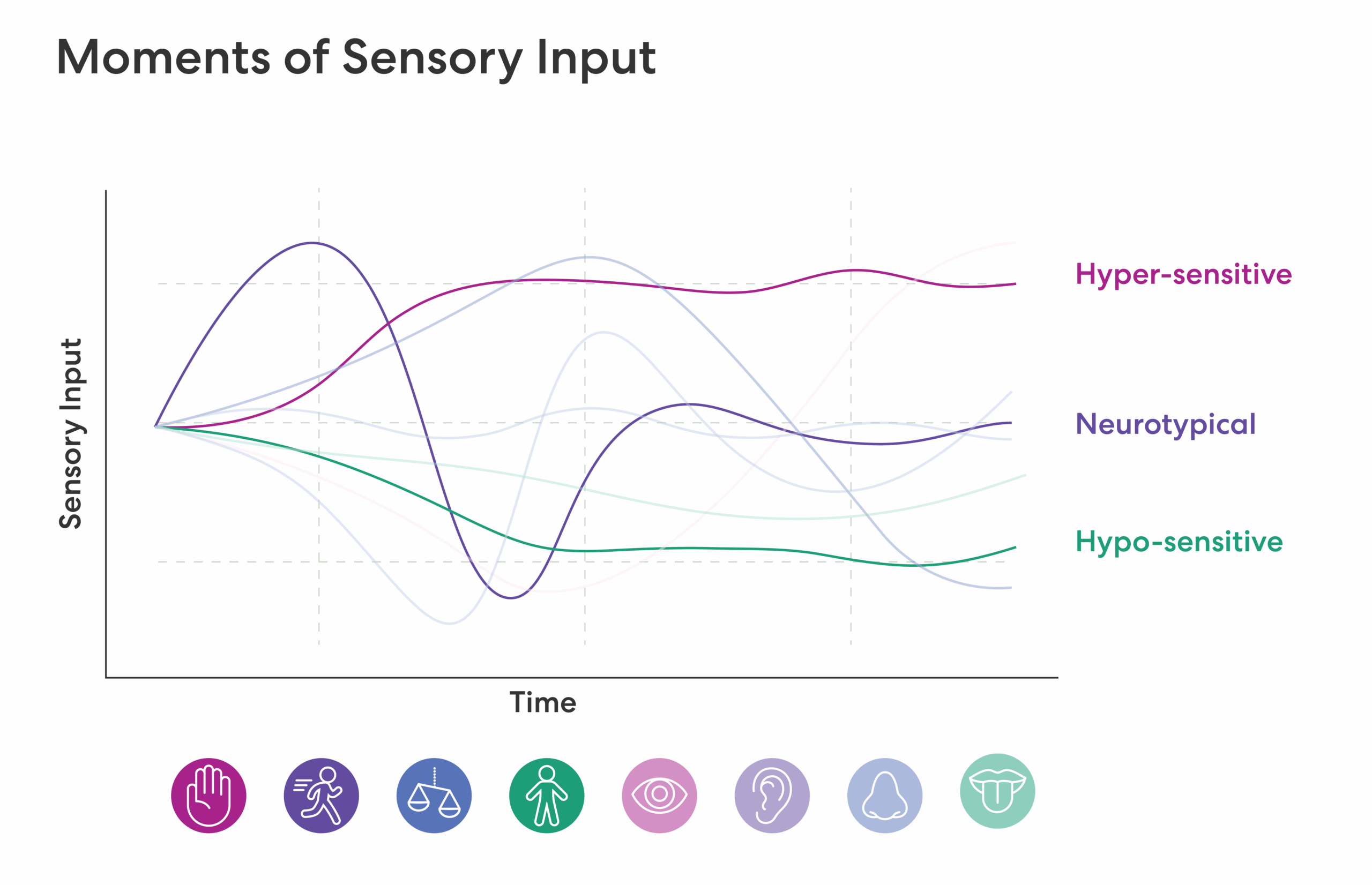
Diagram showing each of the eight senses across time and their different levels of sensory input. Hyper-sensitive, neurotypical, and hypo-sensitive are compared visually.

Sources:
Piccardi & Gliga, 2022
Ward, 2019

Design Frameworks

Designing for the senses begins with the individual. It moves beyond designing for the aesthetic visual sense by considering how each of the eight senses impacts sensory wellness.  Often this takes the form of one-size-fits-one approach to design for the most tailored approach. 

Acknowledging that this is not always feasible, the existing frameworks below highlight best practices.

Multi-sensory design

Moves away from the traditionally visual and aesthetic design models. It investigates how to design buildings in a way that promotes sensory well-being. It frames the built environment as the core focus. Successful multi-sensory design supports our social cognitive, and emotional growth.

ASPECTSS

Evidence based design guidelines for individuals with autism. It maps 7 concepts for spatial design – acoustics, spatial sequencing, escape, compartmentalization, transition, sensory zoning, and safety.

Trauma Informed Design (TiD)

Integrates principles of trauma informed care with design to promote spaces of safety, well-being, and healing.

Why are Sensory Rooms Not Enough?

When we think of sensory rooms most likely an image comes to mind of a dark, enclosed room with soft lighting, fiber optic lights and soft chairs. This is a valid sensory room for one individual, however it meets the needs of only one certain individual. If we question how this space could accommodate someone who is visually impaired, prefers bright spaces or has mobility constraints we may consider alternative sensory designs. A holistic sensory experience has the opportunity to move beyond just one room.

gif of different sensory experiences at different times and in different locations

Sources:
Grace, 2023
National Council for Special Education, 2025

Knowledge Repository

Start your journey with neuroinclusive design at the level that works for you whether that’s: Building your foundational knowledge at Level 100: Core Exploring broader histories and systemic views at Level 200: Context Getting tools you need for intervention at Level 300: Change

100: Core

Language Matters

Begin with words.

Language is connected to our identities. Having a shared language around neuroinclusion is a building block to designing truly inclusive environments.
Download the PDF

Keywords: Person-first language, identity-first language, ableism

200: Context

Neurocognitive Profiles

Coming Soon
Check back soon to take a deep dive into the varying experiences of different neurotypes.

300: Change

Why Sensory Rooms are Not Enough

Coming Soon
Check back soon to investigate the misconceptions of sensory rooms